BlackRock urges OCC to drop tokenized reserve cap idea, expand eligible assets in GENIUS Act comment letter

Quick Take
BlackRock filed a comment letter Friday urging the OCC to scale back several proposed reserve asset restrictions in its draft rules implementing the GENIUS Act.
The world’s largest asset manager opposed a potential 20% cap on tokenized reserve assets, a constraint that would limit products like its BUIDL fund, which backs more than 90% of Ethena’s USDtb and Jupiter’s JupUSD.
BlackRock also asked the agency to confirm that Treasury ETFs qualify as reserves and to add two-year Treasury floating-rate notes to the eligible asset list.
BlackRock submitted a comment letter Friday to the Office of the Comptroller of the Currency pushing back on several proposed reserve asset restrictions in the agency's draft rules implementing the GENIUS Act.
The 17-page response landed on the final day of the OCC's 60-day comment window, which opened when the proposal was published in the Federal Register on March 2. The agency posed more than 200 questions worth of feedback prompts spanning reserve composition, capital, custody, and the yield ban.
BlackRock's submission focuses on the rules governing permitted payment stablecoin issuers, or PPSIs, the federally chartered entities authorized to issue stablecoins under the law signed by President Trump last July.
The most pointed ask: BlackRock urged the OCC not to impose a quantitative cap on tokenized reserve assets, which the agency had floated at a possible 20% threshold. The firm called such a limit "extraneous" to the OCC's objectives and argued that risk profiles are driven by credit quality, duration, and liquidity, "not whether the asset is held or transferred on a distributed ledger."
That position carries weight given BlackRock's tokenization footprint. Its BUIDL fund, among the largest tokenized Treasury products with nearly $2.6 billion in assets per RWA.xyz data, provides over 90% of the reserves backing Ethena's USDtb and Solana-based Jupiter's JupUSD. Circle's USYC currently leads the field with $2.9 billion in AUM, per the data. 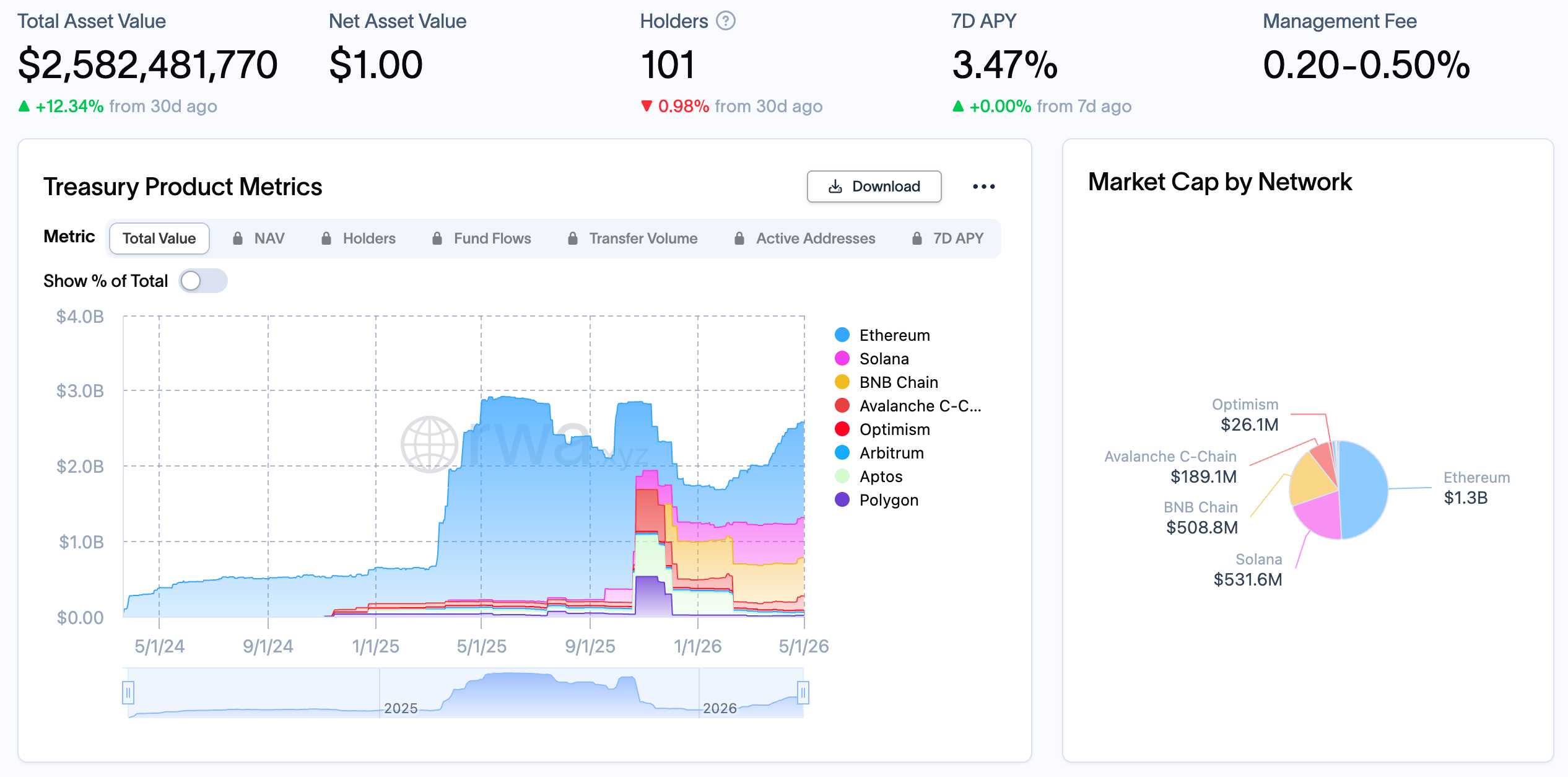
A 20% cap on tokenized reserves would meaningfully constrain BUIDL's growth as a reserve asset under the federal framework.
BlackRock also pressed the OCC to confirm explicitly that exchange-traded funds investing solely in eligible reserve assets, such as Treasury ETFs, qualify as reserves under Section 4 of the GENIUS Act. The firm warned that ambiguity in the proposal could deter PPSIs from holding ETFs in their reserves and asked the agency to extend the same quantitative safe harbor treatment to qualifying ETFs that government money market funds receive.
On reserve diversification, BlackRock backed the OCC's "Option A," which pairs a principles-based standard with an optional quantitative safe harbor. Option B would impose those same standards, including a 40% single-institution concentration limit and a 20-day weighted average maturity ceiling, as mandatory daily requirements for all issuers.
The firm pushed for several mechanical changes to Option A's safe harbor. It asked the OCC to exclude "self-custodied" government money market fund shares from the 40% concentration limit, confirm that PPSIs do not have to look through fund holdings to apply the limit to fund custodians or service providers, and allow same-day-settlement government money market funds to count toward the 30% weekly liquidity requirement.
Beyond the safe harbor, BlackRock recommended adding U.S. Treasury floating-rate notes with up to two years of remaining maturity to the eligible reserve asset list, citing their limited price volatility and weekly coupon resets. It also urged the agency to develop a formal, transparent process for considering additional eligible assets going forward.
The letter was signed by Roland Villacorta, BlackRock's global head of liquidity and financing, and Benjamin Tecmire, head of U.S. regulatory affairs.
BlackRock's input arrives as the firm positions to serve stablecoin issuers under the new regime. In October, it retooled its Select Treasury Based Liquidity Fund (BSTBL) into a GENIUS-compliant product, with a 5 p.m. ET trading deadline and a Treasury-heavy mandate aimed specifically at stablecoin reserves.
The OCC's 376-page proposal is one of several federal rulemakings racing to a January 2027 compliance deadline. The FDIC advanced its own proposed rules in early April, and Treasury, FinCEN, and OFAC have moved separate proposals covering state-level oversight, anti-money-laundering programs, and sanctions compliance.
Other commenters weighed in Friday as well. The Brookings Institution filed its own letter focused on capital requirements, arguing that the OCC should require higher capital charges for uninsured demand deposits held as reserves.